What Is a Sand Calculator — and Why Does It Matter?
A sand calculator is an online tool (or formula) that estimates the volume and weight of sand needed for a given area, based on the length, width, and depth you enter. Instead of eyeballing bags at the store, you input your measurements and get back a precise figure — in cubic feet, cubic yards, cubic meters, kilograms, or tons, depending on what you need.
At sandcalculator.online, the calculator handles all the unit conversions automatically. You choose your shape — rectangle, circle, or cylinder — enter your dimensions, and it tells you exactly how much sand to order. No spreadsheets, no manual arithmetic.
Why does it matter? Because sand is sold by weight and volume, and those two things don't always translate cleanly in your head. A cubic yard of dry sand weighs roughly 2,700 lbs. A cubic yard of wet sand can weigh closer to 3,300 lbs. If you're ordering by the ton, those numbers change again. Getting the estimate wrong means either a shortage mid-project or hundreds of pounds of leftover material you're stuck disposing of.
How to Use the Sand Calculator — Step by Step
The sand calculator formula is straightforward: Volume = Length × Width × Depth. From there, you multiply by the density of sand to get the weight. Here's how it works in practice.
For a Rectangular Area (Patios, Driveways, Lawns)
1. Measure the length and width of your area in feet (or meters).
2. Decide on the depth of sand you need — typically 1–4 inches for a sand base, 1–2 inches for paver sand, and 3–6 inches for a sandbox.
3. Convert depth to the same unit as length and width (e.g., 2 inches = 0.167 feet).
4. Multiply: Volume (cubic feet) = Length × Width × Depth
5. Divide by 27 to convert to cubic yards, or multiply by 0.0283 for cubic meters.
Example: A 10 ft × 12 ft patio with a 2-inch sand base = 10 × 12 × 0.167 = 20.04 cubic feet ≈ 0.74 cubic yards.

For a Circular Area (Round Pools, Circular Patios, Round Pens)
The sand calculator for a circle uses the formula: Volume = π × r² × Depth, where r is the radius (half the diameter).
6. Measure the diameter of the circle.
7. Divide by 2 to get the radius.
8. Apply: Volume = 3.1416 × radius² × depth.
Example: A 15-ft diameter above-ground pool base with a 2-inch sand bed: r = 7.5 ft; Volume = 3.1416 × 56.25 × 0.167 ≈ 29.5 cubic feet ≈ 1.09 cubic yards.
For a Cylindrical Area (Fence Posts, Pillars, Tanks)
For a sand calculator cylinder, the formula is the same as a circle but with a taller depth — typically the height of the cylinder. This is useful for estimating sand for fence post holes or cylindrical aquarium bases.
Sand Calculator for Every Project Type
One of the most common searches online is "sand calculator for pavers" — and it makes sense. Laying paving stones correctly requires a precise sand bed, usually 1 inch of bedding sand on top of a 4-inch compacted gravel base. Too thin and the pavers shift; too thick and they sink unevenly.
Here are the most common project types and their typical sand depths:
Project | Recommended Sand Depth | Notes |
Paver sand / patio base | 1 inch bedding + 4 in. base | Use coarse or sharp sand |
Sandbox | 12–18 inches | Play sand; keep it clean |
Above-ground pool base | 2–3 inches | Fine mason sand works well |
Aquarium substrate | 1–2 inches | Live sand or aragonite |
Lawn leveling / top dressing | ¼–½ inch | Use horticultural sand |
Mortar mix (brickwork) | Per ratio (1:3–1:6) | Sharp or building sand |
Horse arena / equestrian | 4–6 inches | Silica or manufactured sand |
Trench backfill | Variable | Density-compacted layers |
Artificial turf infill | ¼–1 inch | Silica sand infill |
Rendering / screed | Per mix ratio | Builders sand typically |
Sand Calculator in Different Units — Cubic Feet, Cubic Yards, Tons, and Bags
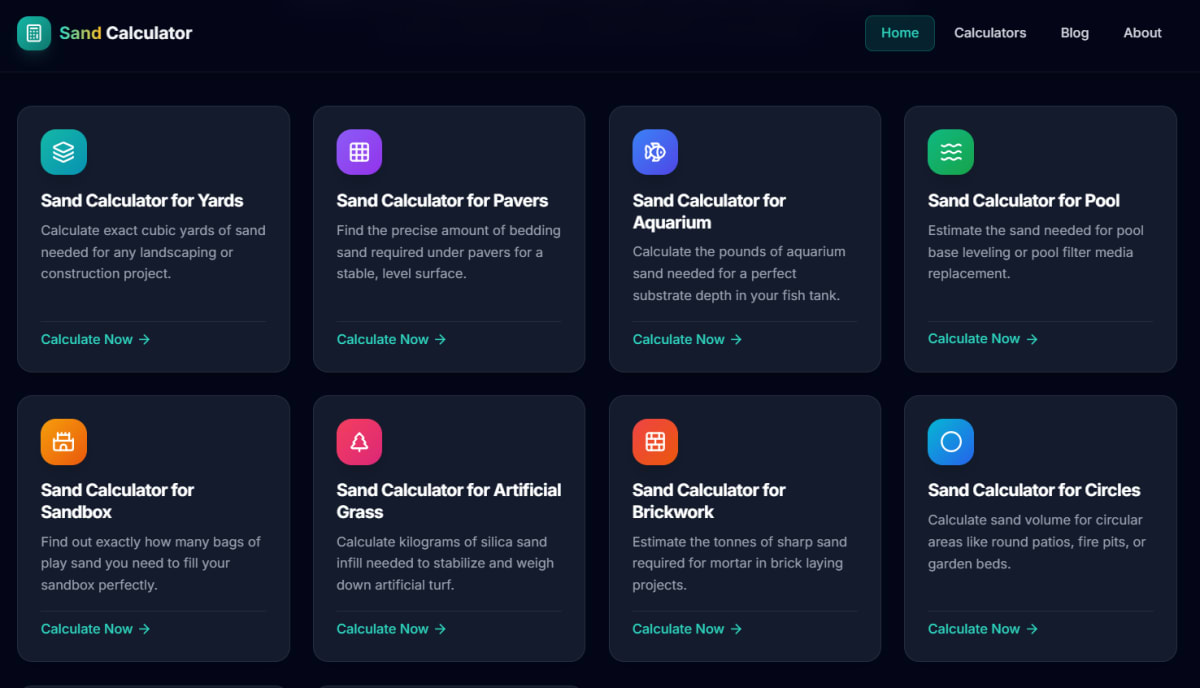
Sand calculator results in cubic yards are the most common format in North America, but different projects call for different units. Here's a quick conversion cheat sheet:
• 1 cubic yard = 27 cubic feet
• 1 cubic meter = 1.308 cubic yards = 35.315 cubic feet
• 1 ton (short) ≈ 0.74 cubic yards (for dry sand at ~2,700 lbs/yd³)
• 1 cubic yard ≈ 13–14 bags of 50-lb sand (13.5 bags exactly)
• 1 cubic yard ≈ 9 bags of 0.5 cubic feet each
The sand calculator in tons is critical when ordering bulk deliveries. Most suppliers quote by the ton, not by the yard, so knowing how many tons your project requires lets you call a supplier with a precise number.
Sand calculator in bags matters when you're doing a smaller job and buying bagged sand from Home Depot, Lowe's, or a local yard. Bags typically come in 50 lbs or 60 lbs.
Weight of Sand: Dry vs. Wet vs. Packed
Sand density varies based on moisture content and how tightly it's packed:
• Dry loose sand: ~1,600 kg/m³ (100 lbs/ft³)
• Dry packed sand: ~1,700 kg/m³
• Wet sand: ~1,900–2,000 kg/m³
• Wet packed sand: ~2,100 kg/m³
The sand weight calculator in kg is particularly useful in metric countries like Australia, the UK, India, New Zealand, and South Africa. One metric tonne = 1,000 kg ≈ 1.102 short tons.
Sand Calculator for Pools — Above Ground and Oval
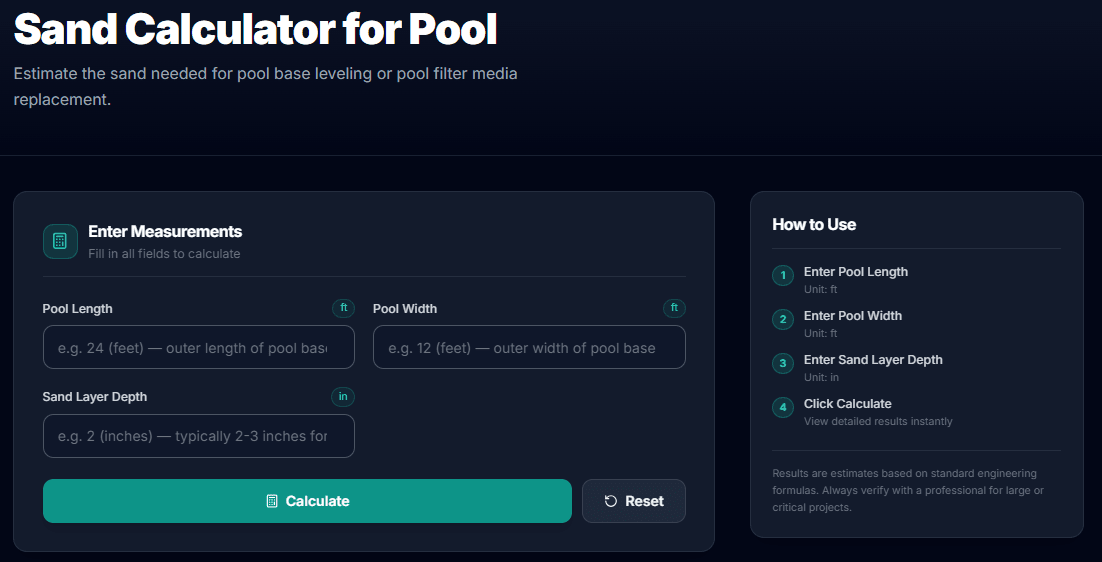
A sand calculator for pool installations is one of the highest-stakes uses because you're dealing with a large circular or oval surface and the wrong depth causes structural problems down the line.
Standard guidance:
• Use mason sand (fine, clean, no rocks).
• Apply a 2-inch layer across the entire base.
• For oval pools, use the ellipse formula: Volume = π × (length/2) × (width/2) × depth.
Example — 15 ft × 24 ft oval pool at 2-inch depth: Volume = 3.1416 × 7.5 × 12 × 0.167 ≈ 47.1 cubic feet ≈ 1.74 cubic yards ≈ about 2.35 short tons.
Sand Calculator for Aquariums — Live Sand, Substrate Depth, and Tank Size
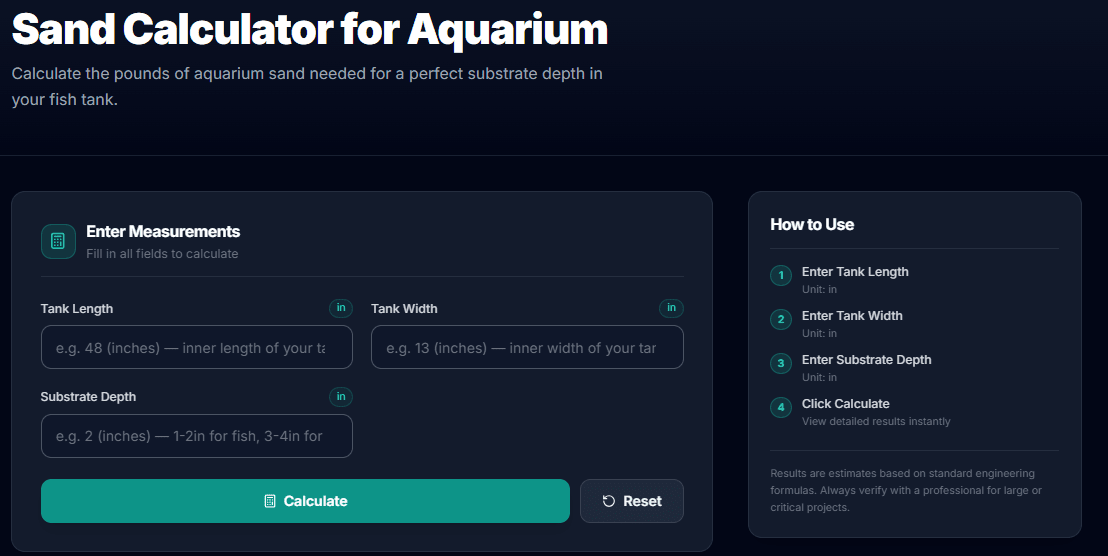
Sand calculator for aquarium projects requires thinking in gallons and inches rather than cubic yards. Reef tank and freshwater aquarium owners typically want a 1–2 inch sand bed, or 4–6 inches for a deep sand bed (DSB) in reef systems.
The sand calculator reef tank formula:
9. Measure tank footprint (length × width, in inches).
10. Multiply by desired depth in inches.
11. Divide by 231 to convert cubic inches to gallons.
12. 1 lb of aragonite or crushed coral ≈ fills ~0.011 gallons to 1 inch depth.
Alternatively: 1 lb of sand per gallon of tank water for a 1-inch bed is a well-established rule of thumb in the hobby.
Sand calculator for aquarium UK users should note that live sand and aragonite are typically sold by weight (kg) — use the metric version of the calculator.
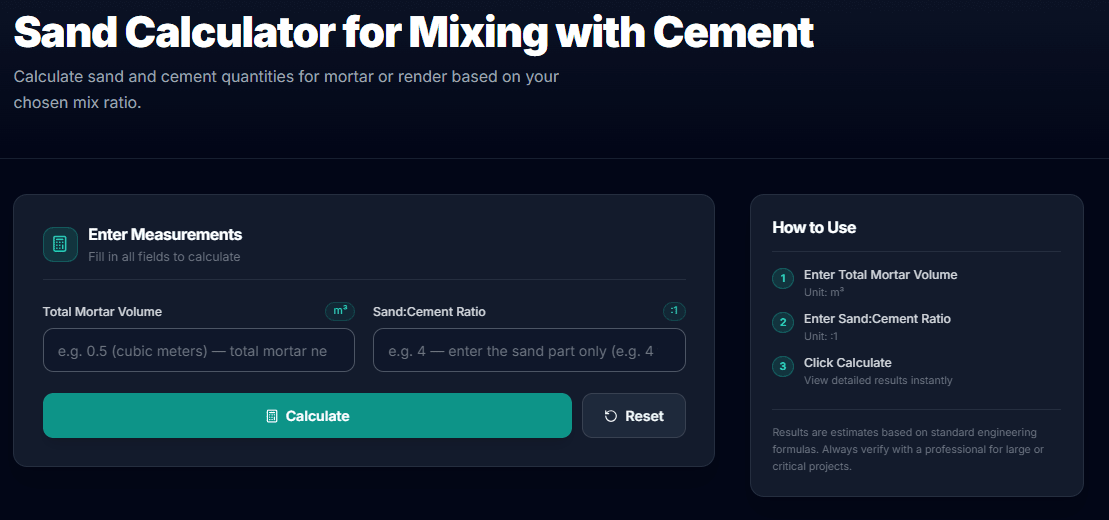
Sand and Cement — Mortar Mix Calculator
Sand cement calculator ratios are one of the most misunderstood aspects of DIY masonry. The ratio depends on the application:
• Brickwork mortar: 1 part cement : 4–6 parts sand (building sand)
• Rendering walls: 1 part cement : 4–5 parts sand
• Concrete (general): 1 : 2 : 4 (cement : sand : gravel)
• Floor screed: 1 part cement : 3–4 parts sand
The sand calculation formula for mortar: Sand volume = Total mortar volume × (sand ratio / (cement ratio + sand ratio)).
For a 1:5 mix producing 1 cubic meter of mortar: Cement = 1/6 × 1.3 ≈ 0.217 m³ ≈ 7 bags of 50 kg. Sand = 5/6 × 1.3 ≈ 1.083 m³ ≈ 1.1 tonnes.
Sand Calculator for Specific Surfaces
Sand Calculator for Sandbox
The sand calculator for sandbox is one of the most searched tools by parents and landscapers alike. A standard sandbox is 4 ft × 4 ft × 12 inches deep = 16 cubic feet ≈ 0.59 cubic yards ≈ 1,600 lbs. That's approximately 32 bags of 50 lbs each.
Sand Calculator for Lawn Leveling / Top Dressing
Sand calculator for lawn top dressing is used to calculate how much sand you need to smooth bumps, fill low spots, or improve drainage. Typical depth: ¼ inch to ½ inch. For a 1,000 sq ft lawn at ¼ inch: Volume ≈ 0.77 cubic yards.
Sand Calculator for Horse Arena / Equestrian
Sand calculator for arena and equestrian sand calculator are critical tools for arena builders. Horse arenas use 4–6 inches of sand footing. For a 60 ft × 120 ft arena at 4 inches: Volume ≈ 88.9 cubic yards ≈ 120 tons.
Sand Calculator for Artificial Turf / Infill
Sand infill calculator for artificial grass estimates silica sand infill needed per square foot. Standard artificial grass uses 1–2 lbs of silica sand per square foot, applied as a base layer.
Sand Calculator Online — UK, Australia, India, and International Units
The sand calculator online at sandcalculator.online works in both imperial and metric units, making it equally useful whether you're a contractor in the US or a builder in the UK, Australia, or India.
• Sand calculator UK: Results in m³, kg, and tonnes. Building sand, sharp sand, and ballast are most common.
• Sand calculator Australia / NZ: Works in m³; suppliers typically sell in tonnes.
• Sand calculator India: Most useful in cubic feet (cft) and kilograms. 1 cft dry sand ≈ 45–46 kg.
• Metric: 1 m³ sand = 1,400–1,700 kg depending on moisture and grain size.
Sand Quantity Calculator — Construction and Civil Engineering
Sand quantity calculator tools are essential for civil engineers and contractors estimating materials for foundations, backfill, trenches, slabs, and road bases.
Sand quantity calculation formula for civil use:
• Volume of wet concrete (m³) × Sand fraction (0.44 for 1:1.5:3 mix) = Sand volume. Multiply by 1.54 for dry sand volume.
• Sand backfill calculator: Volume of trench (L × W × D) minus volume of pipe = sand volume needed. Compact in 6-inch lifts.
Types of Sand — Which One Does Your Project Need?
Sand material calculator results are only useful if you're ordering the right type of sand.
Sand Type | Best Used For |
Play sand / sandbox sand | Fine, washed, no sharp edges. Safe for children. |
Mason sand / fine sand | Pool bases, under pavers, and as mortar sand. |
Sharp sand / coarse sand | Concrete mixes and drainage layers. |
Building sand | Brickwork and rendering mortar. |
Silica sand | Artificial turf infill, industrial filtration, aquariums. |
Ballast | Mixed sand and gravel used in concrete. |
Live sand (reef) | Pre-seeded aragonite for marine reef aquariums. |
Polymeric sand | Paver joints — locks in place when wetted. |
How Much Does Sand Cost? Sand Price Calculator
Sand price calculator estimates depend on your location, the type of sand, and whether you're buying in bags or bulk. General cost ranges in the US (2025):
• Bagged play sand (50 lbs): $5–$8 per bag
• Bagged mason sand (0.5 cu ft): $4–$7 per bag
• Bulk sand (per ton, delivered): $20–$50 per ton depending on region
• Polymeric sand (50 lbs): $15–$30 per bag
Common Sand Calculation Mistakes — and How to Avoid Them
13. Confusing volume and weight. The calculator gives you volume. To get bags or tons, you need density conversion.
14. Not accounting for compaction. Sand compacts 10–20%. Add at least 10% overage to any estimate.
15. Measuring the wrong depth. Measure the depth you want after compaction, not before.
16. Ignoring waste and spillage. Add 5–10% for spills and uneven spreading.
17. Using the wrong sand type. Play sand ≠ masonry sand. Sharp sand ≠ fine sand. Each has different density and compaction.